Fe collar enslavement
Bride of AlvarFe collar enslavement is a condition of magical bondage imposed on Alvar through a Fe collar, a device that converts possession of its key into command over the wearer. The state is both bodily and ethical: it can force Alvar to transform and act against his will, while leaving him to carry shame for violence he did not freely choose. Its removal therefore becomes more than a physical escape; it is the decisive breaking of Saul’s authority over Alvar’s body and life.
Nature and Mechanism
The collar is an enchanted instrument of dark magic. Alvar explains that it remains around his neck even when a noble sylph priestess has blessed it to appear invisible. Its invisibility does not lessen its power. He feels it as the “device of my shame,” a continual reminder that he is enslaved, and he identifies the hidden collar with the loss of the will that should govern his own body.
Control depends on the key. When the person holding it gives an order, the wearer cannot simply refuse; the collar burns, and the command takes precedence over Alvar’s intention. Hyphus makes the mechanism explicit when he tells Alvar that he is now his master and later takes the key, after which Alvar understands that he has lost all free will. The collar thus turns a portable object into a political instrument: authority belongs not to the person wearing it, but to whoever can unlock, activate, and command the binding.
The collar’s operation also reaches into Alvar’s Cursed nature. Saul makes Alvar lock the device himself, causing a burning sensation unlike anything he has previously experienced, despite his immunity to ordinary flames. Alvar changes from man to Cursed and then back to man while panic and icy terror take hold of him. The transformations show that the collar does not merely restrain movement or compel speech. It governs the boundary between Alvar’s human appearance and monstrous form, making his supernatural body available to another person’s will.
Saul’s Enslavement of Alvar
Saul uses the collar to turn Alvar’s inherited power into a weapon. Saul admits that the supposed marriage arrangement surrounding Ysta was a ruse designed to make Alvar accept the collar and become useful to him. Because a Cursed cannot ordinarily be killed without the proper weaponry, Saul sees Alvar’s enslavement as a way to obtain power that would otherwise be inaccessible. He also exploits Alvar’s desire for acceptance and family, presenting trust as the opening through which bondage can be imposed.
Saul’s control is bound to blood as well as metal. He says that his blood was placed in the forge with Alvar’s before Alvar added his own, making the two of them bound together “Forever.” Saul’s claim that he lied about the arrangement exposes the collar as a trap rather than a pact between equals. Alvar has no meaningful choice once the collar is locked, and Saul’s possession of the silver key allows him to keep Alvar confined until he devises another attack.
The consequences are catastrophic for others as well as for Alvar. Under Saul’s command, Alvar becomes the instrument of death-dealing, and the taste of innocent blood remains on his tongue after an entire town is killed except for one survivor. Saul uses that survivor to spread his name and threaten other villages with the same fate if they refuse submission. Alvar’s body is therefore made into an extension of Saul’s tyranny: the collar allows Saul to command the violence, while Alvar is left to experience its physical aftermath and moral residue.
Hyphus and the Reproduction of Control
After Saul’s rule, the collar continues to generate new relations of domination. Hyphus recognizes Alvar as the same person he knew in another life, when the two had been family, but approaches that history through accusation rather than reconciliation. He insists that Alvar possessed enough power to stop his father’s actions and blames him for failing to do so. When Hyphus takes control of the collar, he intends not only to command Alvar but to make him feel the helplessness that Hyphus associates with Alvar’s earlier misdeeds.
Alvar’s response shows the difference between responsibility and control. He says that he had nothing to do with his father’s actions, yet Hyphus answers that possessing power and doing nothing made Alvar culpable in his eyes. The collar then burns, and Alvar knows that his free will has disappeared. Hyphus’s accusation does not restore agency; it becomes the justification for reproducing the same coercive structure. He orders Alvar to attend a ritual in which a slave girl’s virtue blood will be spilled on the altar of Hedomas, turning Alvar’s supposed punishment into another occasion for forced participation in violence.
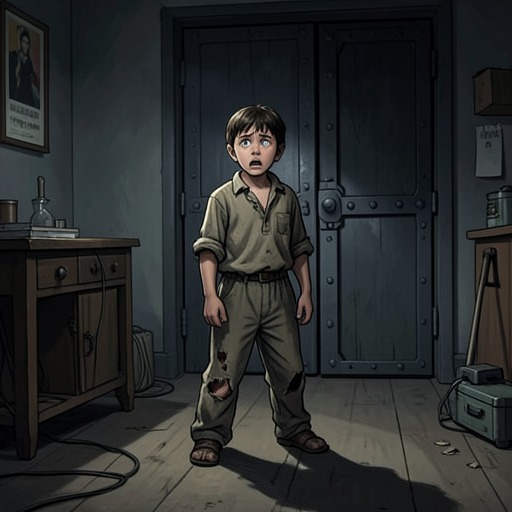
Under the command, Alvar enters the hole where he had lived when Saul had no use for him and unleashes the Cursed. His body stretches into the monster he fears he has always been, while wings erupt from his back and the transformation’s pain sears through his flesh. The scene makes the collar’s cruelty concrete: Alvar’s body does not merely obey an external command; it is physically compelled to expose the form that has been used to define and degrade him.
Trauma, Shame, and Moral Agency
Alvar does not treat coerced violence as morally irrelevant. He remains ashamed of what the collar made him do, and he preserves some memories of those acts as a punishment for his own naivety and his refusal to let others become close to him. At the same time, he erases memories of Saul’s sexual abuse from the Mystar because he cannot bear to see them again. The distinction matters: the memories of forced evil become a self-imposed record of guilt, while the memories of degradation are removed as an intolerable wound.
Alvar later reveals that Saul used him for sexual acts he would never have chosen freely. Saul fetishized Alvar’s suffering and his Curse and used that abuse to make psychological intimacy with anyone else more difficult. This extends the collar’s power beyond commands issued in a particular room. Saul’s domination survives as shame, secrecy, damaged trust, and the conviction that Alvar is too distorted to be loved. The binding therefore controls not only action but the conditions under which Alvar imagines himself capable of human attachment.
Alvar’s public confession confronts the same problem from the opposite direction. Speaking to the people of Underland, he identifies himself as the monster Saul used to enslave them and explains that Saul placed the Fe collar on him after his family rejected him for carrying the Curse. He describes the collar as a device whose keyholder can control the wearer and admits that he concealed his origins because he feared that the people would shun him and abandon his mission to free Underland. The confession does not erase the deaths committed through his body, but it separates willing tyranny from compelled service and makes his concealed history available for judgment.
Destruction and Significance
The final confrontation turns the collar’s command structure against itself. Saul orders Alvar to obey while holding the key from a pendant around his neck. Alvar fights the command, protects Lucy Hammond, and refuses to hurt her, but the spell causes violent shaking, pain, and another forced change of form. Lucy then uses fire as a means of attack and forces the stolen key into the collar’s lock while Alvar is in his monstrous state.
When the key turns, Alvar groans, the collar falls away, and the device melts into a blood-like pool. His flames vanish, his Cursed form folds back into that of a man, and Saul’s immediate control ends. The release is costly: Lucy Hammond is badly wounded and losing blood, while Alvar collapses after the collar is destroyed. Freedom arrives not as a clean restoration but through mutual risk, bodily exhaustion, and the destruction of the object that made Saul’s power repeatable.
Fe collar enslavement consequently functions as the central material image of Alvar’s captivity. The hidden metal around his neck embodies inherited shame, forced violence, sexual exploitation, and the fear that others will mistake a controlled body for a willing monster. Its key dramatizes the transfer of agency to a master, while its melting marks the possibility that responsibility can be confronted without allowing coercion to define a person forever. The state ends when the collar is destroyed, but the narrative makes clear that liberation must also contend with the memories, relationships, and moral injuries left behind by years of command.